Comprehensive Eye Care & Vision Correction in Incheon · Multilingual International Concierge
23+ Years Clinical Experience
en-US


Ophthalmology Guide
Why Lens Implants Are the Best Solution for Clear Vision After Cataract Surgery
Discover why lens implants are the best solution for clear vision after cataract surgery. Restore focus, reduce dependency on glasses—learn more today!
Schedule a ConsultationIntroduction
For most people, vision loss from cataracts doesn’t happen overnight. It’s gradual — a soft blurring of colors, a dulling of light, and a growing struggle to read or drive at night. You may start noticing halos around lamps or that the world looks as though it’s covered in a faint film.
Understanding Cataracts: When the World Grows Dim
The human eye works much like a camera. Light passes through the cornea and the natural lens, which focuses it onto the retina at the back of the eye. When the natural lens becomes cloudy — due to age, ultraviolet exposure, or other metabolic changes — light can no longer focus properly. This clouding is what we call a cataract.
What Exactly Is a Lens Implant?
A lens implant, or intraocular lens (IOL), is a small, artificial lens inserted into your eye to replace the natural one removed during cataract surgery. Made of high-grade biocompatible materials, the IOL stays in your eye permanently and requires no maintenance or replacement.
The Evolution of Lens Implants: From Clarity to Customization
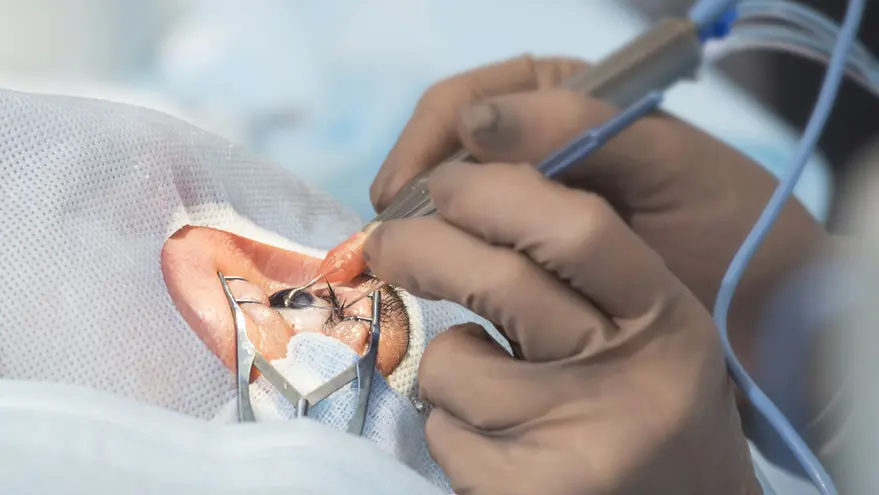
The earliest IOLs, developed in the 1950s, provided only basic focus for distance vision. They restored clarity but required patients to wear reading glasses afterward. Today, however, the field has evolved dramatically.
1. Monofocal Lenses – Clear, Reliable Distance Vision
These lenses are set for one distance, typically far vision. You’ll see clearly when driving, watching TV, or walking outdoors but may still need glasses for reading.
For patients who value crisp, high-contrast vision — such as drivers or golfers — monofocal lenses remain an excellent, cost-effective choice.
2. Toric Lenses – For Astigmatism Correction
If you have astigmatism, where the cornea’s curvature is uneven, a toric lens can correct that distortion. Before toric lenses were available, even successful cataract surgery often required glasses afterward. Now, toric IOLs can deliver sharp, distortion-free vision, often without any need for glasses.
3. Multifocal and Trifocal Lenses – Freedom from Glasses
For those who prefer full visual independence, multifocal and trifocal lenses offer a continuous range of focus — near, intermediate, and far. They work much like progressive glasses but without the frames or visual “zones.”
Patients can move seamlessly from reading a book to checking their phone or spotting a sign across the street.
4. EDOF (Extended Depth of Focus) Lenses – Natural Vision Across Distances
The newest innovation in IOL design, EDOF lenses offer smooth, continuous vision across a wide range — from intermediate to far — with fewer side effects like halos. They’re ideal for patients who spend time on digital devices or prefer comfortable night vision with minimal visual disturbances.
Why Lens Implants Are Superior to Glasses or Contacts After Surgery
A question we hear often is: “Why can’t I just wear glasses after cataract surgery?”
- They don’t fog, scratch, or dry out like contact lenses.
- They remain perfectly centered, even as you move your eyes.
- They don’t need replacement or daily care.
- They can correct multiple refractive issues at once — cataracts, astigmatism, and presbyopia.
The Science of Precision: How Personalized Cataract Surgery Works

No two eyes are the same. That’s why modern cataract surgery, especially at a leading center like ours, begins with advanced diagnostics.
- Optical coherence biometry to measure eye length and curvature.
- Corneal topography to map the surface shape of your cornea.
- Wavefront analysis to detect subtle optical imperfections.
- Laser-assisted surgical systems for pinpoint precision in lens placement.
The Long-Term Benefits of Lens Implants
When properly selected and implanted, an intraocular lens can last a lifetime. Unlike natural lenses, they don’t grow cloudy or degrade over time. Here are some of the long-term advantages patients can expect:
- Permanent clarity – The IOL never develops another cataract.
- Stability – No ongoing adjustments or replacements needed.
- Customized correction – The lens is uniquely matched to your eye shape.
- Reduced dependency on glasses – Many patients enjoy full visual freedom.
- Future-proof vision – Compatible with most future eye treatments, should you need them.
Why Choosing the Right Clinic Matters
Conclusion: A Clearer Tomorrow Starts with a Single Decision
More Articles
Continue reading our ophthalmology guides and vision care insights.

SMILE vs LASIK: Recovery Benchmarks for Vision Correction Care
South Korea has solidified its position as a global epicenter for ophthalmology, with the domestic LASIK and refractive surgery market projected to reach **USD 167.37 million by 2035**, growing at a steady CAGR of 8.54%.
Learn More

Prevalence of Myopia in Korea: The Value of Dream Lens Therapy
The prevalence of myopia among young people in South Korea has reached critical levels, often described as a "myopia epidemic." According to recent data from the **Korean National Health and Nutrition Examination Survey (KNHANES)**, the prevalence of myopia...
Learn More

Multidisciplinary Care: The Future of Korean Pediatric Eye Clinics
The landscape of pediatric eye care in South Korea is shifting rapidly. With nearly **21.9% of Korean children** estimated to be affected by various visual disorders according to nationwide health screenings, the demand for specialized intervention has never...
Learn More