Comprehensive Eye Care & Vision Correction in Incheon · Multilingual International Concierge
23+ Years Clinical Experience
en-US


Ophthalmology Guide
Why Cataract Surgery with Presbyopia Correction Is Popular Over 50
Discover why cataract surgery with presbyopia correction is popular for those over 50. Improve vision, reduce glasses dependence & enjoy clearer sight—learn more!
Schedule a ConsultationIntroduction: When Vision Begins to Change
For most of our adult lives, we rarely pause to think about our eyes. They work quietly, seamlessly, helping us navigate work, family, travel, and daily routines. But around the age of 50, something begins to shift. Text messages blur, menus in dimly lit restaurants require holding at arm’s length, and night driving feels more stressful than it used to.
Cataracts: The Gradual Clouding of Vision
Cataracts occur when the natural lens of the eye becomes cloudy over time. At first, it may feel like looking through a foggy window. Colors lose brightness, fine details fade, and bright lights at night scatter into glare. By the time people reach their 60s or 70s, cataracts are almost inevitable — the World Health Organization estimates that cataracts remain the leading cause of visual impairment worldwide.
Presbyopia: The Inescapable Need for Reading Glasses
Presbyopia is a different but equally frustrating change. Starting in the early 40s, the natural lens stiffens and loses flexibility. Suddenly, reading up close requires effort, and the once-sharp focus at near distances disappears. Reading glasses or bifocals become a daily necessity. For many, this feels like a marker of aging that is impossible to ignore.
The Convergence After 50: When Two Conditions Meet
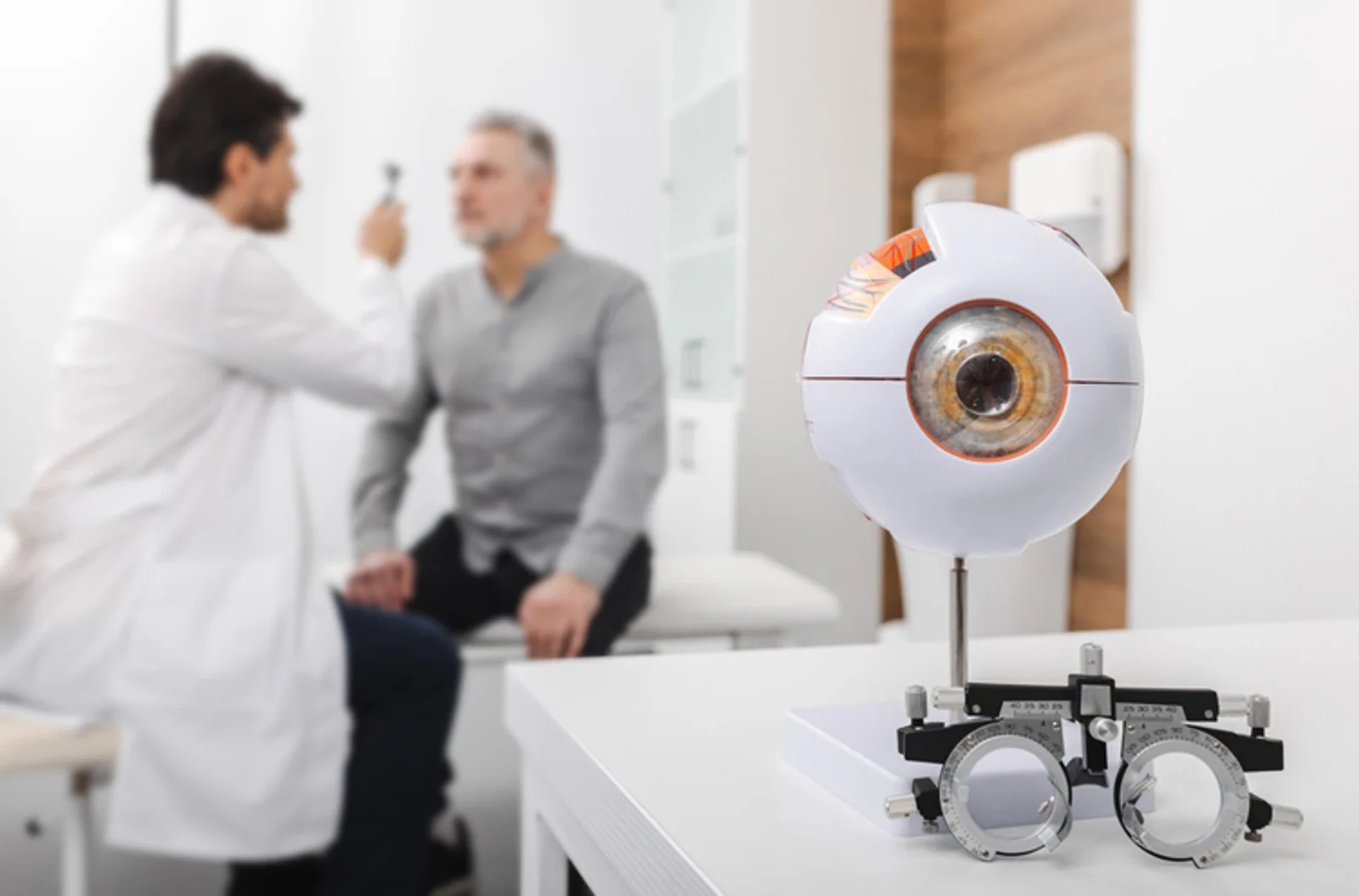
By the time patients reach their 50s, cataracts and presbyopia often overlap. Distance vision becomes clouded, near vision requires glasses, and the frustration compounds. It is at this stage that many patients decide not only to treat the cataract but to address presbyopia as well. Instead of undergoing surgery only to remain dependent on glasses, they ask for something more: clear vision across all distances.
Presbyopia-Correcting Intraocular Lenses: A Modern Solution
The cornerstone of this combined approach is the advanced intraocular lens. Unlike traditional monofocal lenses, which correct vision at only one distance, multifocal, trifocal, and extended depth-of-focus (EDOF) lenses provide clarity at near, intermediate, and far distances. This means patients can:
- Read a book or smartphone
- Work comfortably on a computer
- Drive safely, even at night
- Recognize faces and enjoy nature without needing glasses
The Emotional Dimension of Vision Decline
It is easy to think of cataract surgery as a purely medical procedure, but for patients, it is far more personal. Vision is tied to identity, independence, and confidence. Losing the ability to read without glasses, or hesitating to drive at night, often feels like losing a piece of autonomy.
How the Procedure Works
The procedure is typically performed under local anesthesia, with no need for hospital admission. Using laser-assisted or ultrasound techniques, the cloudy lens is gently removed. An artificial intraocular lens is then implanted in its place. The choice of IOL makes all the difference:
- Monofocal IOL: Focuses at one distance; usually requires glasses for near tasks.
- Multifocal or trifocal IOL: Offers clarity across near, intermediate, and far distances.
- Extended depth-of-focus IOL: Provides smoother transitions, ideal for computer work and general tasks.
Long-Term Benefits for Patients Over 50
For patients who choose cataract surgery with presbyopia correction, the results often feel life-changing. Benefits include:
- Clear vision at all distances — near, intermediate, and far
- Reduced dependence on glasses — especially reading glasses
- Enhanced safety and confidence — particularly for night driving
- Permanent improvement — intraocular lenses do not wear out
- Improved lifestyle quality — patients resume hobbies like golf, knitting, and traveling without limitation
Is It Right for Everyone?

While presbyopia-correcting cataract surgery offers remarkable benefits, it is not suitable for all patients. Those with advanced glaucoma, macular degeneration, or other retinal conditions may need alternative options. A detailed evaluation is essential to determine candidacy.
Why More Patients Are Choosing This Path
The Global Ubal Eye Center Approach
Conclusion: Regaining Independence, Not Just Vision
More Articles
Continue reading our ophthalmology guides and vision care insights.

SMILE vs LASIK: Recovery Benchmarks for Vision Correction Care
South Korea has solidified its position as a global epicenter for ophthalmology, with the domestic LASIK and refractive surgery market projected to reach **USD 167.37 million by 2035**, growing at a steady CAGR of 8.54%.
Learn More

Prevalence of Myopia in Korea: The Value of Dream Lens Therapy
The prevalence of myopia among young people in South Korea has reached critical levels, often described as a "myopia epidemic." According to recent data from the **Korean National Health and Nutrition Examination Survey (KNHANES)**, the prevalence of myopia...
Learn More

Multidisciplinary Care: The Future of Korean Pediatric Eye Clinics
The landscape of pediatric eye care in South Korea is shifting rapidly. With nearly **21.9% of Korean children** estimated to be affected by various visual disorders according to nationwide health screenings, the demand for specialized intervention has never...
Learn More