Comprehensive Eye Care & Vision Correction in Incheon · Multilingual International Concierge
23+ Years Clinical Experience
en-US

Ophthalmology Guide
When to Schedule Your Child’s First Eye Exam: Expert Advice
Expert advice on when to schedule your child’s first eye exam, key milestones, and signs to watch for. Ensure healthy vision—learn more today!
Schedule a ConsultationIntroduction: Why Timing Matters More Than You Think
Every parent treasures the moments when their child sees the world with fresh eyes — pointing out a butterfly in the park, flipping through their first picture book, or waving excitedly at a teacher across the classroom. These are not just cute milestones. They are signs of vision in action, shaping how a child learns, connects, and grows.
Why Early Eye Exams Are Essential
Vision is more than just eyesight. It’s a partnership between the eyes and the brain. During the first eight years of life, this partnership is especially delicate, and problems during this window can have lasting consequences.
- Roughly 1 in 20 preschoolers has a significant vision disorder.
- Myopia (nearsightedness) is growing at an alarming rate in East Asia. In South Korea, studies show that over 80% of high school students are myopic — a trend influenced by intense study culture and prolonged near work.
- Conditions like congenital cataracts or retinopathy of prematurity, though less common, require urgent diagnosis to save vision.
The Pediatric Eye Exam Timeline
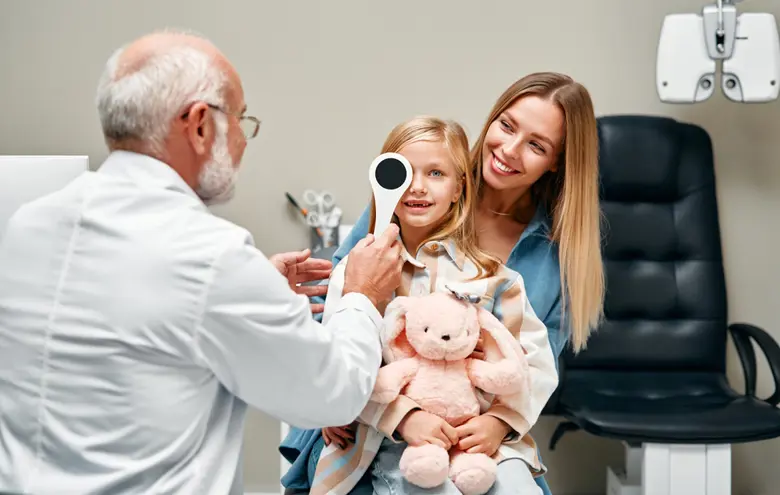
There is no single “one-size-fits-all” schedule for children, but ophthalmologists recommend key milestones based on age and developmental stages. At Global Ubal Eye Center, we emphasize three critical checkpoints:
1. Newborn and Infant Screening (Birth–6 months)
Most hospitals perform an initial red reflex test after birth to detect major issues like congenital cataracts or retinal abnormalities. However, if a baby is born prematurely, has a family history of eye disease, or shows unusual eye movements, parents should schedule a more detailed exam with a pediatric ophthalmologist.
2. Preschool Exam (Around Age 3–4)
This is often the first comprehensive exam. At this age, children can participate in simple visual acuity tests using pictures or shapes. Doctors check for:
- Refractive errors (nearsightedness, farsightedness, astigmatism)
- Strabismus (misalignment)
- Depth perception
- Amblyopia risk
- General eye health
3. School Readiness Exam (Age 5–6)
Before entering primary school, every child should have a full eye exam. Clear vision is fundamental to learning letters, reading the board, and writing confidently. Even minor issues, such as astigmatism, can affect concentration.
4. Ongoing Follow-Ups (Every 1–2 years)
From this point forward, regular exams ensure that vision develops normally. Children who wear glasses or have progressive myopia may need check-ups every six months.
When to Schedule Sooner: Warning Signs Parents Should Watch For
While milestone ages are helpful, parents should not wait if certain behaviors appear. Some early red flags include:
- Physical signs: Frequent squinting, head tilting, or covering one eye.
- Behavioral changes: Avoiding books, difficulty recognizing familiar faces, or loss of interest in activities requiring visual focus.
- Complaints: Headaches, eye strain, or blurred vision — though many children cannot articulate this clearly.
- Visible misalignment: Eyes that appear crossed, drifting, or not moving together.
What Happens During a Pediatric Eye Exam?
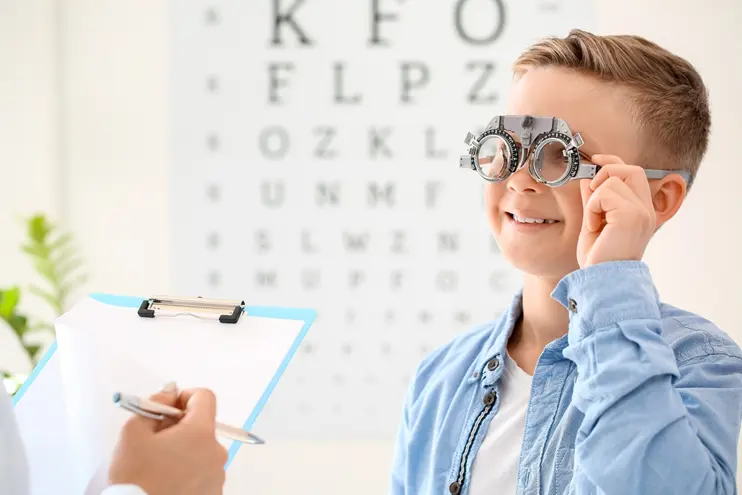
Parents often imagine eye exams as intimidating, filled with bright lights and complex machines. In reality, pediatric eye care is designed to be gentle, engaging, and child-friendly.
Myths Parents Often Believe (and Why They’re Risky)
In Korea, as in many countries, parents sometimes delay exams because of common misconceptions. Here are a few we hear often:
- “If my child can see cartoons, their eyes are fine.” Not true. A child may see close-up objects but still struggle with distance vision or depth perception.
- “Wearing glasses makes the eyes dependent.” Glasses do not weaken vision. On the contrary, they support proper eye development by ensuring both eyes work together.
- “Eye exams are only needed if problems appear.” Unfortunately, many serious conditions — such as amblyopia — may not have obvious symptoms.
- “Screen time is the only cause of poor eyesight.” While prolonged near work does contribute to myopia, genetics and other health factors play major roles.
The Long-Term Impact of Early Eye Care
Why Families Choose Global Ubal Eye Center
Conclusion: A Clearer Tomorrow Starts Today
More Articles
Continue reading our ophthalmology guides and vision care insights.

SMILE vs LASIK: Recovery Benchmarks for Vision Correction Care
South Korea has solidified its position as a global epicenter for ophthalmology, with the domestic LASIK and refractive surgery market projected to reach **USD 167.37 million by 2035**, growing at a steady CAGR of 8.54%.
Learn More

Prevalence of Myopia in Korea: The Value of Dream Lens Therapy
The prevalence of myopia among young people in South Korea has reached critical levels, often described as a "myopia epidemic." According to recent data from the **Korean National Health and Nutrition Examination Survey (KNHANES)**, the prevalence of myopia...
Learn More

Multidisciplinary Care: The Future of Korean Pediatric Eye Clinics
The landscape of pediatric eye care in South Korea is shifting rapidly. With nearly **21.9% of Korean children** estimated to be affected by various visual disorders according to nationwide health screenings, the demand for specialized intervention has never...
Learn More