Comprehensive Eye Care & Vision Correction in Incheon · Multilingual International Concierge
23+ Years Clinical Experience
en-US

Ophthalmology Guide
Presbyopia Treatment During Cataract Surgery: Best for Clear Vision
Presbyopia treatment during cataract surgery restores clear vision at all distances. Discover the best options to reduce glasses dependence—learn more today!
Schedule a ConsultationIntroduction: Why Clear Vision Matters at Every Age
Vision is not just about seeing. It’s about reading your grandchild’s note, driving safely at night, recognizing a friend’s smile across a café, or catching the fine details of a painting you’ve always loved. When vision fades, daily life feels smaller. Two of the most common reasons for this decline — presbyopia and cataracts — often appear together in midlife and beyond.
Understanding Presbyopia: The “Short Arm Syndrome”
Presbyopia is universal. No matter how healthy your eyes are, the natural lens inside will eventually stiffen with age. This reduces its ability to change shape — the mechanism that allows you to switch focus from far to near.
- Difficulty reading menus in dim restaurants.
- Needing brighter light for close work.
- Frequent switching between distance and reading glasses.
- Eye strain after working on the computer.
Cataracts: More Than Just Blurry Vision
Cataracts occur when the natural lens becomes cloudy, scattering light instead of focusing it sharply. While aging is the most common cause, factors like diabetes, UV exposure, smoking, and certain medications can speed up cataract formation.
- Cloudy or dim vision.
- Glare and halos around lights.
- Faded colors.
- Difficulty driving at night.
Cataract Surgery: From Sight Restoration to Vision Optimization
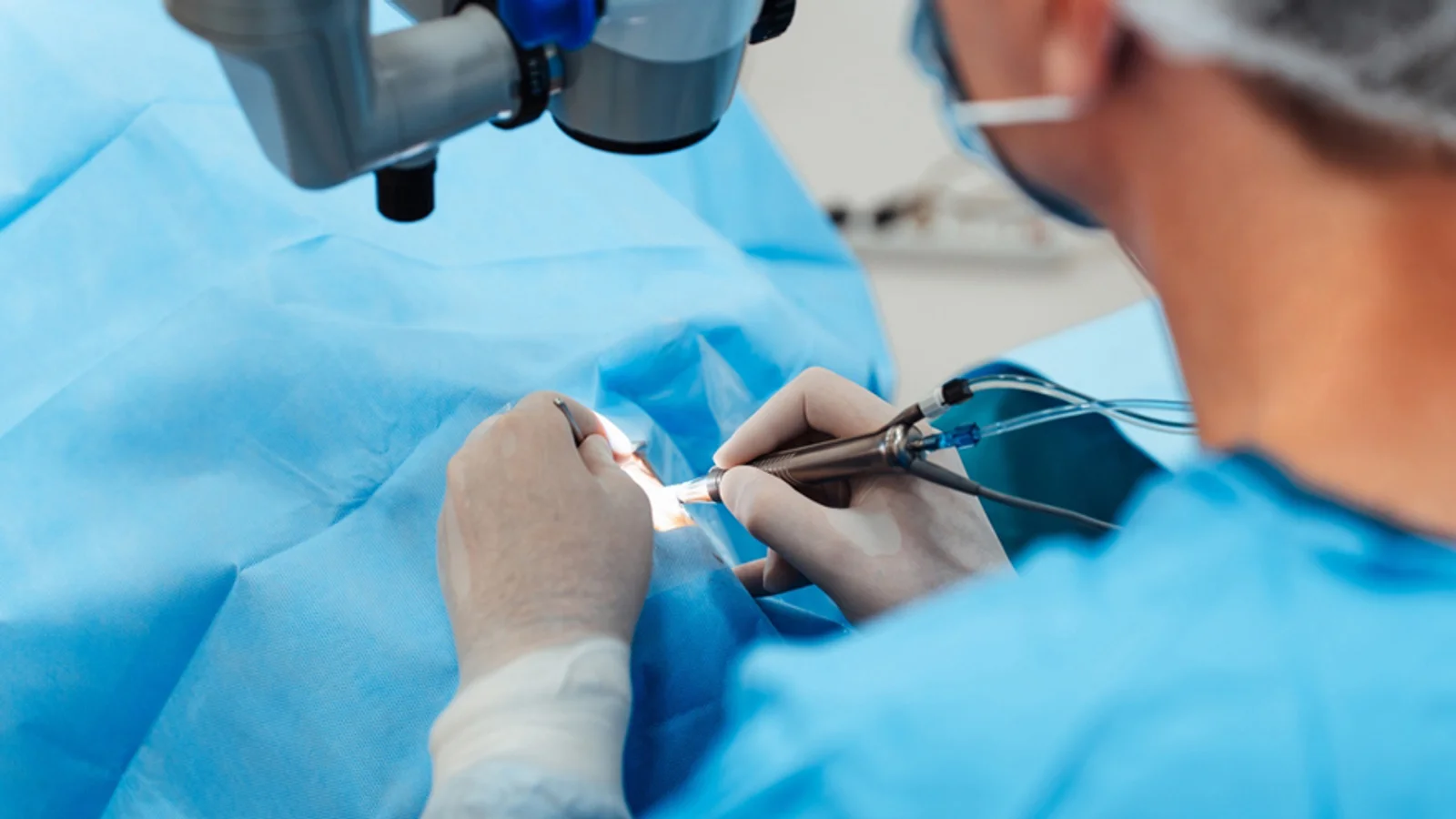
Traditional cataract surgery involves removing the cloudy lens and replacing it with a clear intraocular lens (IOL). In the past, most IOLs were “monofocal,” designed to provide clear distance vision only. Patients gained sharpness but usually needed reading glasses.
Presbyopia Treatment Options During Cataract Surgery
At Global Ubal Eye Center, we customize lens selection for each patient. The main options include:
Multifocal Intraocular Lenses (IOLs)
These lenses contain multiple focal zones, allowing patients to focus at different distances.
- Benefits: High independence from glasses. Great for active individuals who read, use computers, and drive.
- Limitations: Some patients may notice halos or glare, particularly at night.
Extended Depth of Focus (EDOF) Lenses
EDOF lenses extend the range of clear vision by creating a “stretched focus.” They provide excellent distance and intermediate vision, with functional near vision.
- Benefits: Fewer halos than multifocals, good balance for drivers and computer users.
- Limitations: Fine print may still require glasses.
Accommodating IOLs
These lenses attempt to mimic the natural focusing ability of the eye by shifting position slightly inside the eye.
- Benefits: More natural vision transition.
- Limitations: Effectiveness may decline over time.
Monovision Approach
In some cases, one eye is corrected for distance and the other for near. The brain blends the two images.
- Benefits: Can work well for those who already adapted to monovision with contact lenses.
- Limitations: Depth perception may be reduced; not everyone adapts comfortably.
Lifestyle Factors That Influence the Best Choice
Lens selection is deeply personal. At our clinic, we don’t just measure eyes — we ask about life. Questions we consider include:
- Do you drive frequently at night?
- Do you spend hours on a computer or smartphone?
- Do you enjoy outdoor activities like hiking, golf, or cycling?
- Do you read fine print often, or mostly consume digital content?
- How important is total independence from glasses to you?
Why It’s Wise to Treat Presbyopia During Cataract Surgery

Patients often wonder whether they should just treat the cataract now and deal with presbyopia later. But combining the treatments makes sense for several reasons:
The Global Ubal Eye Center Difference
At Global Ubal Eye Center, led by Dr. Heecheol Bae, MD, PhD, we emphasize precision and personalization in cataract and presbyopia treatment.
- Advanced diagnostics: Using topography, optical biometry, and retinal imaging, we create a detailed map of the eye.
- Experience: With more than 23 years of surgical expertise, Dr. Bae has helped thousands of patients restore vision.
- Multilingual support: We provide care in Korean, English, Japanese, Mongolian, and Russian, making our center a trusted choice for local and international patients.
- Compassionate approach: We see surgery as more than a medical act — it’s about helping people regain confidence, independence, and quality of life.
What to Expect After Surgery
Frequently Asked Questions
Conclusion: Clarity and Freedom in One Step
More Articles
Continue reading our ophthalmology guides and vision care insights.

SMILE vs LASIK: Recovery Benchmarks for Vision Correction Care
South Korea has solidified its position as a global epicenter for ophthalmology, with the domestic LASIK and refractive surgery market projected to reach **USD 167.37 million by 2035**, growing at a steady CAGR of 8.54%.
Learn More

Prevalence of Myopia in Korea: The Value of Dream Lens Therapy
The prevalence of myopia among young people in South Korea has reached critical levels, often described as a "myopia epidemic." According to recent data from the **Korean National Health and Nutrition Examination Survey (KNHANES)**, the prevalence of myopia...
Learn More

Multidisciplinary Care: The Future of Korean Pediatric Eye Clinics
The landscape of pediatric eye care in South Korea is shifting rapidly. With nearly **21.9% of Korean children** estimated to be affected by various visual disorders according to nationwide health screenings, the demand for specialized intervention has never...
Learn More