Comprehensive Eye Care & Vision Correction in Incheon · Multilingual International Concierge
23+ Years Clinical Experience
en-US

Ophthalmology Guide
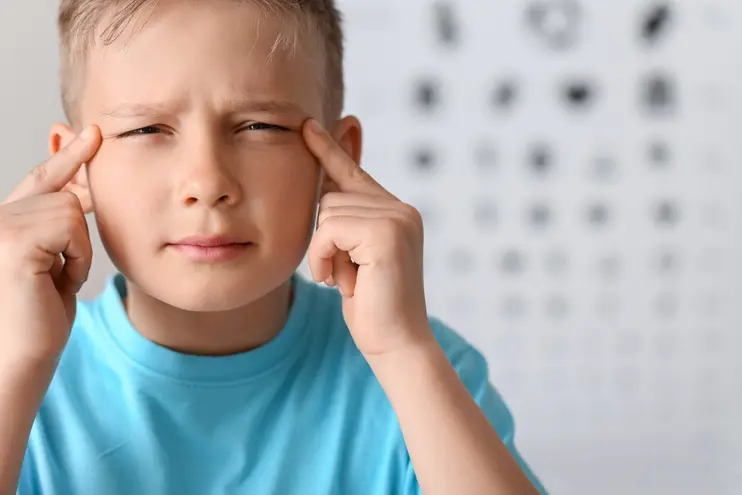
Is Your Child Squinting? It Could Be a Vision Problem
Is your child squinting often? It may signal a vision problem. Discover causes, signs, and treatment options to protect their eyesight. Learn more today.
Schedule a ConsultationIntroduction: When a Small Habit Signals a Bigger Concern
Every parent knows their child better than anyone else. You notice the way your son tilts his head when concentrating, or how your daughter sits close to the television during her favorite shows. Among these small details, one behavior often stands out: squinting.
Why Do Children Squint?
To understand squinting, it helps to imagine the eye as a camera. When the camera lens is slightly out of focus, the image looks blurry. Squinting is like pressing the aperture tighter — it reduces the scatter of light entering the eye, sharpening the image temporarily. For a child, this is an instinctive way to see more clearly.
Nearsightedness (Myopia)
Children with myopia see nearby objects clearly but struggle with distant ones. This is why a child may squint at the classroom board but not while drawing. Myopia is particularly common in Korea, where intensive reading and screen use during childhood play a role.
Farsightedness (Hyperopia)
Hyperopia causes difficulty focusing on close-up tasks, such as reading or writing. Squinting helps the eyes focus better at short distances.
Astigmatism
When the cornea or lens has an irregular shape, light does not focus evenly on the retina. This leads to distorted or blurred vision, and children may squint to reduce the distortion.
Amblyopia (Lazy Eye)
If one eye is weaker, the brain may start favoring the stronger eye. Squinting can sometimes be a compensatory behavior, although amblyopia often requires more specific treatment such as patching therapy.
Strabismus (Eye Misalignment)
When the eyes are not aligned properly, children may squint to try and reduce double vision or confusion between the two eyes.
The Consequences of Untreated Vision Problems

It is tempting for parents to think that squinting will simply disappear with time. However, untreated vision problems during childhood can have long-lasting effects.
Academic Challenges
In Korea, where education is a central part of a child’s life, clear vision is essential. Children with uncorrected myopia or other vision issues may struggle to see the classroom board or follow along in textbooks. Teachers might misinterpret this as a lack of concentration, when in fact the child simply cannot see clearly.
Confidence and Behavior
Vision problems often go unnoticed by children themselves. They may assume everyone sees the world the same way. Over time, however, frustration sets in. A child who cannot keep up with classmates may avoid reading aloud or withdraw from activities. Some parents have told us that they initially suspected attention-deficit issues, only to discover that the root problem was poor eyesight.
Physical Strain
Children with uncorrected vision issues often experience headaches, eye rubbing, or fatigue. These symptoms can interfere with study, play, and overall well-being.
How Pediatric Eye Exams Reveal the Problem
The good news is that pediatric eye exams are simple, safe, and effective. At Global Ubal Eye Center, our examinations are tailored specifically for children. We use gentle approaches and playful methods so that the process feels comfortable rather than intimidating.
- Refractive status: Determining whether glasses are needed, and at what strength.
- Binocular coordination: Assessing how well the two eyes work together.
- Eye alignment: Checking for strabismus or subtle misalignments.
- Visual acuity development: Ensuring both eyes are maturing at the right pace.
- Overall eye health: Screening for early signs of eye disease or congenital issues.
The Importance of Early Detection
A child’s visual system develops rapidly in the first years of life. By the age of 8 to 10, the brain’s visual pathways are largely established. This means that conditions such as amblyopia are far easier to correct when discovered early.
Signs Parents Can Watch For at Home
Parents are often the first to notice potential vision problems. Beyond squinting, here are other behaviors that may signal a need for an eye exam:
- Sitting unusually close to the television or holding books very near the face
- Tilting or turning the head frequently while reading or focusing
- Covering one eye with a hand during tasks
- Difficulty catching or hitting balls, suggesting poor depth perception
- Frequent headaches, eye rubbing, or complaints of tired eyes
- Struggling with reading, writing, or focusing on homework
Lifestyle and Environmental Factors

Beyond Glasses: Comprehensive Pediatric Vision Care
Why Families Trust Global Ubal Eye Center
Conclusion: Protecting a Child’s Window to the World
More Articles
Continue reading our ophthalmology guides and vision care insights.

SMILE vs LASIK: Recovery Benchmarks for Vision Correction Care
South Korea has solidified its position as a global epicenter for ophthalmology, with the domestic LASIK and refractive surgery market projected to reach **USD 167.37 million by 2035**, growing at a steady CAGR of 8.54%.
Learn More

Prevalence of Myopia in Korea: The Value of Dream Lens Therapy
The prevalence of myopia among young people in South Korea has reached critical levels, often described as a "myopia epidemic." According to recent data from the **Korean National Health and Nutrition Examination Survey (KNHANES)**, the prevalence of myopia...
Learn More

Multidisciplinary Care: The Future of Korean Pediatric Eye Clinics
The landscape of pediatric eye care in South Korea is shifting rapidly. With nearly **21.9% of Korean children** estimated to be affected by various visual disorders according to nationwide health screenings, the demand for specialized intervention has never...
Learn More