Comprehensive Eye Care & Vision Correction in Incheon · Multilingual International Concierge
23+ Years Clinical Experience
en-US

Ophthalmology Guide
Is Your Child Squinting a Lot? It Might Be a Vision Issue
Discover why frequent squinting may signal vision problems in children. Learn the signs, causes, and treatment options to protect your child’s eyesight.
Schedule a ConsultationIntroduction: Small Habits, Big Clues
Parenting is often about noticing the little things. You catch when your child suddenly stops liking a certain food, when they’re unusually quiet after school, or when they develop a new habit like twirling their hair. Some habits are simply part of growing up. But others—especially those that repeat day after day—can hold deeper meaning.
Why Children Squint: More Than Just a Habit
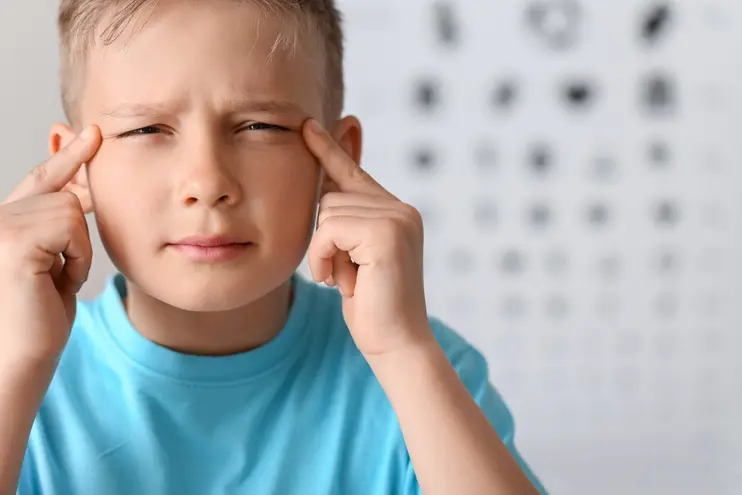
Squinting is essentially a biological trick. By narrowing the eyelids, less light enters the eye, and the circle of light on the retina becomes smaller. This reduces blur and can temporarily sharpen vision. Adults sometimes do the same thing without realizing—like when trying to read a distant road sign. But in children, frequent squinting usually means that the eyes are working harder than they should.
1. Myopia (Nearsightedness)
This is by far the most frequent culprit, especially in East Asia. Children with myopia see nearby objects clearly but struggle with things farther away—like the blackboard, classroom projector, or TV. South Korea, in particular, has one of the highest rates of childhood myopia in the world, linked to intensive academic environments and high amounts of near work (studying, reading, using digital devices).
2. Hyperopia (Farsightedness)
Though less common than myopia, hyperopia can make close tasks like reading or drawing more difficult. Children with hyperopia sometimes squint while doing homework, often accompanied by eye rubbing or complaints of tiredness.
3. Astigmatism
Astigmatism occurs when the cornea or lens is irregularly curved, creating blurry or distorted vision at all distances. For children, this often means squinting, tilting the head, or struggling to see clearly despite sitting close to an object.
4. Amblyopia (Lazy Eye)
With amblyopia, the brain starts favoring one eye over the other. This can cause squinting, covering one eye, or difficulty with depth perception. Without treatment, amblyopia can lead to permanent vision loss in the weaker eye.
5. Strabismus (Eye Misalignment)
If the eyes don’t align properly, children may squint or close one eye to avoid double vision. Sometimes the misalignment is subtle and only noticeable when the child is tired.
6. Environmental or Temporary Causes
Not all squinting points to a structural issue. Sometimes glare from sunlight, dry eyes, or even fatigue can trigger squinting. However, if the behavior is consistent, it’s best not to dismiss it as temporary.
The Hidden Impact of Vision Problems

Parents often ask: “If my child is squinting but still doing well in school, is it really a problem?” The answer is yes. Vision issues don’t just affect eyesight—they ripple through every part of a child’s life.
- Learning: Up to 80% of classroom learning is visual. If the board is blurry, a child may struggle academically, even if they are intelligent and hardworking.
- Confidence: Children who can’t see clearly may withdraw from classroom participation or sports, feeling they can’t keep up with peers.
- Behavior: Some children labeled as “distracted” or “daydreamers” are actually struggling to see properly.
- Emotional well-being: Constant eye strain can cause irritability, fatigue, and frustration.
What Parents Should Watch For (Beyond Squinting)
While squinting is an important red flag, there are other subtle signs that parents can look out for:
- Sitting very close to screens or holding books close to the face
- Frequent eye rubbing, especially during reading
- Tilting the head or covering one eye
- Complaints of headaches or eye strain
- Trouble catching balls or frequent clumsiness
- Avoiding reading, drawing, or homework
Pediatric Eye Exams: What to Expect
Many parents hesitate to bring children for an eye exam, worrying it will be uncomfortable or overwhelming. But modern pediatric eye exams are designed to be gentle and even engaging.
Treatment Options for Children
When a vision issue is diagnosed, treatment is tailored to the child’s needs.
A Real-World Story from the Clinic
The Cultural Context: Why Vision Care Matters in Korea
When to Seek Immediate Care
Conclusion: Seeing the World Through Your Child’s Eyes
More Articles
Continue reading our ophthalmology guides and vision care insights.

SMILE vs LASIK: Recovery Benchmarks for Vision Correction Care
South Korea has solidified its position as a global epicenter for ophthalmology, with the domestic LASIK and refractive surgery market projected to reach **USD 167.37 million by 2035**, growing at a steady CAGR of 8.54%.
Learn More

Prevalence of Myopia in Korea: The Value of Dream Lens Therapy
The prevalence of myopia among young people in South Korea has reached critical levels, often described as a "myopia epidemic." According to recent data from the **Korean National Health and Nutrition Examination Survey (KNHANES)**, the prevalence of myopia...
Learn More

Multidisciplinary Care: The Future of Korean Pediatric Eye Clinics
The landscape of pediatric eye care in South Korea is shifting rapidly. With nearly **21.9% of Korean children** estimated to be affected by various visual disorders according to nationwide health screenings, the demand for specialized intervention has never...
Learn More