Comprehensive Eye Care & Vision Correction in Incheon · Multilingual International Concierge
23+ Years Clinical Experience
en-US


Ophthalmology Guide
Is My Child’s Vision Normal? When to Schedule Their First Eye Exam
Wondering if your child’s vision is normal? Discover signs to watch for and when to schedule their first eye exam. Learn more to protect their eyesight today.
Schedule a ConsultationIntroduction: The Hidden Struggle Behind a Child’s Smile
One of the most common surprises we see at Global Ubal Eye Center is the look of relief on a parent’s face when they discover the reason behind their child’s difficulties.
How Children’s Vision Develops: More Than Meets the Eye
Human vision is not fully formed at birth. Instead, it evolves step by step, shaped by both biology and environment.
- At birth: Newborns can only see blurry outlines, focusing best at about 20–30 cm — just enough to recognize a caregiver’s face during feeding.
- By 6 months: Babies develop depth perception and begin tracking moving objects. Eye coordination strengthens.
- By age 3–5: Visual acuity (sharpness), color perception, and binocular vision (both eyes working together) mature. This is when children typically achieve near-adult vision.
- By school age: Fine visual skills — essential for reading, writing, and sports — come into play.
The Silent Nature of Pediatric Vision Problems

One of the biggest challenges in pediatric eye care is that children adapt. If vision is blurry, they don’t always say, “I can’t see well.” Instead, they:
- Move closer to the TV or hold books close to their face
- Squint, tilt their head, or cover one eye to focus
- Rub their eyes often, especially after reading
- Avoid activities requiring clear sight — such as puzzles, sports, or drawing
- Struggle with concentration in school, sometimes mistaken for attention problems
Common Childhood Eye Conditions Parents Should Know
At Global Ubal Eye Center, we see a wide range of pediatric eye conditions. Here are the most frequent ones, explained in simple terms:
Amblyopia (Lazy Eye)
- One eye doesn’t develop normal vision because the brain favors the other.
- Often linked to strabismus (eye misalignment) or unequal refractive errors.
- Best treated before age 7–8 with patching, corrective lenses, or vision therapy.
Strabismus (Crossed Eyes)
- The eyes don’t align properly — one may turn inward, outward, up, or down.
- Can cause double vision or lead to amblyopia if untreated.
- Treatment may involve glasses, exercises, or surgery depending on severity.
Refractive Errors (Myopia, Hyperopia, Astigmatism)
- Myopia (nearsightedness) is increasingly common, especially in East Asia.
- Hyperopia (farsightedness) can make close work difficult.
- Astigmatism causes blurred or distorted vision at all distances.
- All can be corrected with glasses, contact lenses, or in older teens, orthokeratology (“Dream Lenses”).
Congenital Issues (Cataract, Glaucoma, Retinal Disorders)
- Rare but serious — these can threaten vision from birth.
- Require early specialist intervention.
When Should My Child’s First Eye Exam Be?
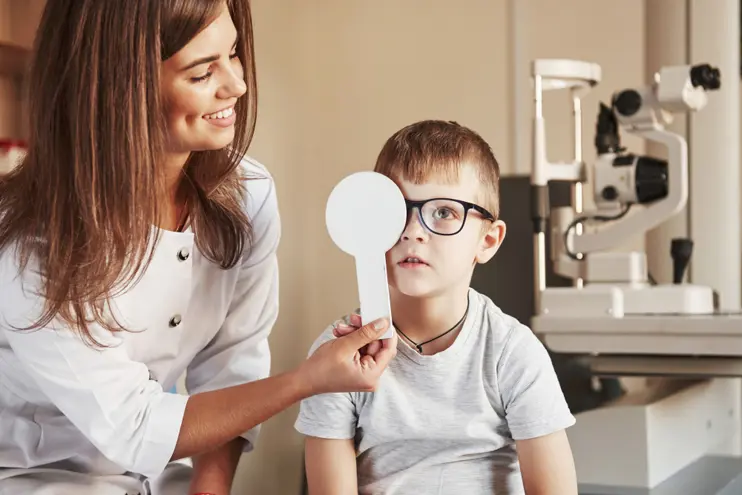
Pediatric ophthalmologists recommend structured eye screening at key stages:
- Infants (6–12 months): A simple exam ensures no congenital cataract, glaucoma, or misalignment. Pediatricians often handle this first check.
- Preschool (around 3 years): The first comprehensive exam — crucial for detecting amblyopia, strabismus, or focusing problems.
- Before First Grade (5–6 years): A must, even if no issues are suspected. School demands prolonged near and distance vision.
Why Early Screening Is About More Than Eyesight
To be honest, it’s not just about catching disease. It’s about giving children confidence in learning, play, and relationships.
Pediatric Eye Care at Global Ubal Eye Center
We understand that children are not just “small adults.” Their exams require special care. At our Incheon clinic, pediatric assessments include:
- Child-friendly testing tools: Age-appropriate eye charts, visual games, and non-invasive imaging.
- Advanced diagnostics: Digital refraction systems, corneal mapping, retinal scans.
- Comfort-focused care: Gentle communication, patient explanations, and multilingual support for international families.
Supporting Healthy Vision at Home
Conclusion: A Clear Future Begins with a Simple Check
More Articles
Continue reading our ophthalmology guides and vision care insights.

SMILE vs LASIK: Recovery Benchmarks for Vision Correction Care
South Korea has solidified its position as a global epicenter for ophthalmology, with the domestic LASIK and refractive surgery market projected to reach **USD 167.37 million by 2035**, growing at a steady CAGR of 8.54%.
Learn More

Prevalence of Myopia in Korea: The Value of Dream Lens Therapy
The prevalence of myopia among young people in South Korea has reached critical levels, often described as a "myopia epidemic." According to recent data from the **Korean National Health and Nutrition Examination Survey (KNHANES)**, the prevalence of myopia...
Learn More

Multidisciplinary Care: The Future of Korean Pediatric Eye Clinics
The landscape of pediatric eye care in South Korea is shifting rapidly. With nearly **21.9% of Korean children** estimated to be affected by various visual disorders according to nationwide health screenings, the demand for specialized intervention has never...
Learn More