Comprehensive Eye Care & Vision Correction in Incheon · Multilingual International Concierge
23+ Years Clinical Experience
en-US

Ophthalmology Guide
How Pediatric Eye Exams Detect Learning Disabilities Early
Discover how pediatric eye exams detect learning disabilities early, boost vision health, and support learning success. Book your child’s exam today!
Schedule a ConsultationIntroduction: More Than Just Clear Vision
When a child enters school for the first time, parents often focus on uniforms, supplies, and building good study habits. Yet, one of the most overlooked foundations of academic success is healthy vision. Children rely on their eyes for nearly 80% of learning activities—whether it’s reading a sentence, copying notes, or recognizing shapes on the board.
Why Vision Plays Such a Vital Role in Learning
Imagine trying to learn piano while hearing some of the keys out of tune, or trying to run while one shoe is tied too tightly. The body still functions, but the difficulty makes every task harder. This is what a child with untreated vision problems experiences daily.
- Eye tracking allows children to follow a line of text without skipping words.
- Focusing ability enables smooth transitions between near and far tasks, like looking up at the board and back down to a notebook.
- Binocular coordination ensures both eyes work together to form a single, clear image.
- Depth perception helps with sports, navigating stairs, and spatial awareness in group settings.
- Visual memory supports spelling, math problems, and remembering sight words.
What Pediatric Eye Exams Really Look For

Many parents assume a vision test at school is enough. But those screenings typically only check visual acuity—the ability to see letters clearly at a set distance. Comprehensive pediatric eye exams, however, are much more detailed.
- Visual acuity at both near and far distances.
- Eye alignment to detect conditions like strabismus (crossed eyes).
- Convergence and divergence to see how well eyes work together.
- Focusing skills to measure how quickly and accurately the eyes adjust.
- Eye movement and tracking while reading or following moving objects.
- Visual processing—how the brain interprets, remembers, and organizes visual information.
The Overlap Between Vision Problems and Learning Disabilities
Parents often ask: Can vision problems cause dyslexia? The answer is no—dyslexia is a language-based condition. But vision problems can imitate its symptoms or make them worse. For example:
- A child with convergence insufficiency may lose their place or skip lines while reading, much like a child with dyslexia.
- A child with uncorrected farsightedness may avoid books, seeming uninterested in learning.
- A child with poor focusing skills may get distracted quickly, resembling ADHD.
- A child with tracking difficulties may have trouble following rows of text, similar to comprehension problems.
Why Early Detection Matters So Much
The earlier we detect a vision-related problem, the easier it is to treat and the faster a child can recover academically. Research shows that children who receive treatment for vision issues experience:
- Increased reading speed and comprehension.
- Better focus and classroom behavior.
- Greater academic confidence.
- Reduced frustration and anxiety about schoolwork.
- Improved relationships with teachers and peers due to better participation.
Real-World Case Examples
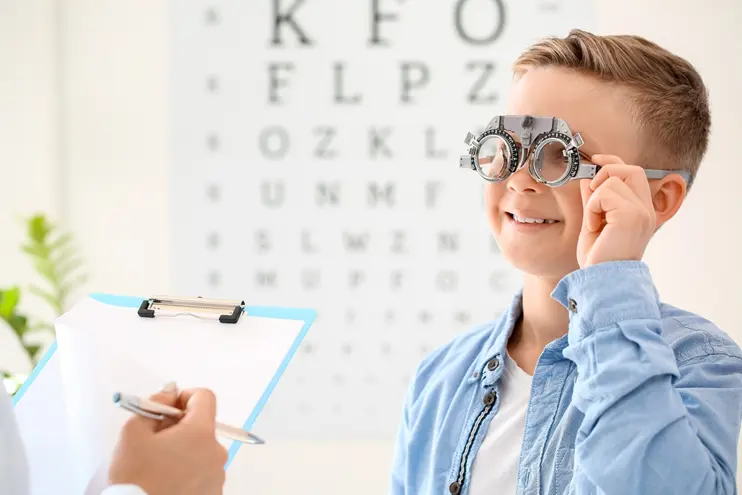
At Global Ubal Eye Center, we often meet families who feel lost after months of watching their child struggle. One mother brought in her 8-year-old son, convinced he had dyslexia because he constantly skipped words while reading. After testing, we found convergence insufficiency.
The Approach at Global Ubal Eye Center
Our clinic has over 23 years of experience treating children with diverse eye conditions. Led by Dr. Heecheol Bae, MD, PhD, our pediatric ophthalmology team combines advanced diagnostic tools with a compassionate, child-centered approach.
- Corrective lenses or contact lenses.
- Vision therapy to improve eye coordination.
- Surgical options when necessary for alignment issues.
- Long-term monitoring to ensure stable improvement.
Cultural Considerations in Korea
In South Korea, children often spend long hours studying, both at school and in private academies (hagwons). This can strain the visual system, particularly when children already have undiagnosed eye problems. Unlike in some countries, where play and outdoor activity balance screen time, many Korean children face near-constant exposure to books, tablets, and screens.
Practical Signs Parents Should Watch For
Conclusion: Giving Children the Vision to Succeed
More Articles
Continue reading our ophthalmology guides and vision care insights.

SMILE vs LASIK: Recovery Benchmarks for Vision Correction Care
South Korea has solidified its position as a global epicenter for ophthalmology, with the domestic LASIK and refractive surgery market projected to reach **USD 167.37 million by 2035**, growing at a steady CAGR of 8.54%.
Learn More

Prevalence of Myopia in Korea: The Value of Dream Lens Therapy
The prevalence of myopia among young people in South Korea has reached critical levels, often described as a "myopia epidemic." According to recent data from the **Korean National Health and Nutrition Examination Survey (KNHANES)**, the prevalence of myopia...
Learn More

Multidisciplinary Care: The Future of Korean Pediatric Eye Clinics
The landscape of pediatric eye care in South Korea is shifting rapidly. With nearly **21.9% of Korean children** estimated to be affected by various visual disorders according to nationwide health screenings, the demand for specialized intervention has never...
Learn More