Comprehensive Eye Care & Vision Correction in Incheon · Multilingual International Concierge
23+ Years Clinical Experience
en-US


Ophthalmology Guide
Cataract Surgery Options for Better Near and Distance Vision
Explore cataract surgery options to improve near and distance vision with IOLs like monofocal, multifocal, and toric lenses for optimal results.
Schedule a ConsultationIntroduction
Cataracts are one of the most common eye conditions, especially as we age, and they can significantly impact your ability to see clearly. Over time, the natural lens inside your eye becomes cloudy, leading to blurred vision, difficulty with glare, and faded colors. Cataract surgery is a safe and effective procedure to remove the cloudy lens and replace it with an artificial intraocular lens (IOL).
Monofocal IOLs: Single Focus Vision
Monofocal IOLs have been the traditional choice for cataract surgery for many years. These lenses provide clear vision at one fixed distance—near, intermediate, or far—depending on what you need.
- Best for: Patients who wish to focus on improving their distance vision or near vision but not both. For example, some people opt for a monofocal lens designed for distance vision, which allows them to see clearly while driving, watching television, and engaging in other activities that require focus on distant objects. Alternatively, if reading glasses are more of a concern, a monofocal lens for near vision might be the best option.
- Advantages: Monofocal IOLs are reliable, widely available, and typically more affordable than other advanced lens options. They are proven to provide clear vision and are often the go-to choice for cataract surgery.
- Disadvantages: While effective for one particular focal length, patients who select a monofocal lens will likely still need glasses for the other type of vision. For instance, if you opt for a lens to correct distance vision, you may still need reading glasses for close-up tasks.
Multifocal IOLs: Vision at Multiple Distances
Multifocal IOLs offer a significant advancement over traditional monofocal lenses. These lenses are designed with multiple rings that allow light to focus at various distances—near, intermediate, and far—allowing the eye to focus on objects at different ranges without needing glasses.
- Best for: People who want to reduce or eliminate their dependence on glasses for both near and far vision. For example, you may be able to see well while driving, reading a book, or working on a computer without needing separate corrective lenses.
- Advantages: Multifocal IOLs provide a high degree of visual independence, reducing the need for glasses. This is particularly appealing to individuals who are tired of constantly switching between prescription glasses for different tasks.
- Disadvantages: Some patients may experience visual disturbances, such as glare, halos, or difficulty with night vision. While these side effects tend to improve over time, they can be bothersome in certain situations, such as when driving at night.
Accommodating IOLs: Flexible Focus for Natural Vision
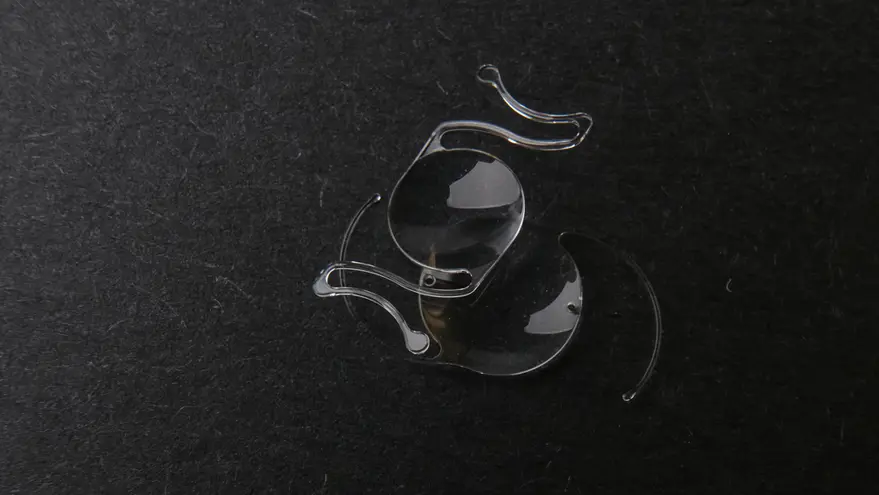
Accommodating IOLs are designed to mimic the natural focusing ability of the eye. These lenses move or change shape inside the eye, allowing them to provide clear vision at multiple distances. They are often described as the next best thing to natural vision, as they aim to restore the eye’s ability to focus at different ranges without the need for glasses.
- Best for: Patients who want both near and far vision without relying on glasses. Accommodating IOLs are a good option for people who are looking for a more natural range of vision that doesn’t require constant adjustment, like shifting between glasses.
- Advantages: The natural focusing ability of accommodating IOLs provides patients with an improved visual experience. This is especially beneficial for people who desire more flexibility in their daily activities, including working on a computer, reading, and watching television.
- Disadvantages: While accommodating lenses offer a continuous range of vision, they may not provide as sharp near vision as multifocal lenses. As a result, you might still need reading glasses for very small print or close-up tasks.
Toric IOLs: Correcting Astigmatism
Toric IOLs are designed specifically for patients who have astigmatism in addition to cataracts. Astigmatism is a refractive error caused by an irregularly shaped cornea or lens, which can result in blurry or distorted vision at all distances. Toric IOLs are designed to correct astigmatism while also treating the cataract, improving clarity of vision.
Extended Depth of Focus (EDOF) IOLs: Continuous Clarity
Why Choose Global UBAL Eye Center?

Conclusion: Choosing the Right IOL for Your Needs
More Articles
Continue reading our ophthalmology guides and vision care insights.

SMILE vs LASIK: Recovery Benchmarks for Vision Correction Care
South Korea has solidified its position as a global epicenter for ophthalmology, with the domestic LASIK and refractive surgery market projected to reach **USD 167.37 million by 2035**, growing at a steady CAGR of 8.54%.
Learn More

Prevalence of Myopia in Korea: The Value of Dream Lens Therapy
The prevalence of myopia among young people in South Korea has reached critical levels, often described as a "myopia epidemic." According to recent data from the **Korean National Health and Nutrition Examination Survey (KNHANES)**, the prevalence of myopia...
Learn More

Multidisciplinary Care: The Future of Korean Pediatric Eye Clinics
The landscape of pediatric eye care in South Korea is shifting rapidly. With nearly **21.9% of Korean children** estimated to be affected by various visual disorders according to nationwide health screenings, the demand for specialized intervention has never...
Learn More